What the Airflow Around a Car Looks Like
October 2026
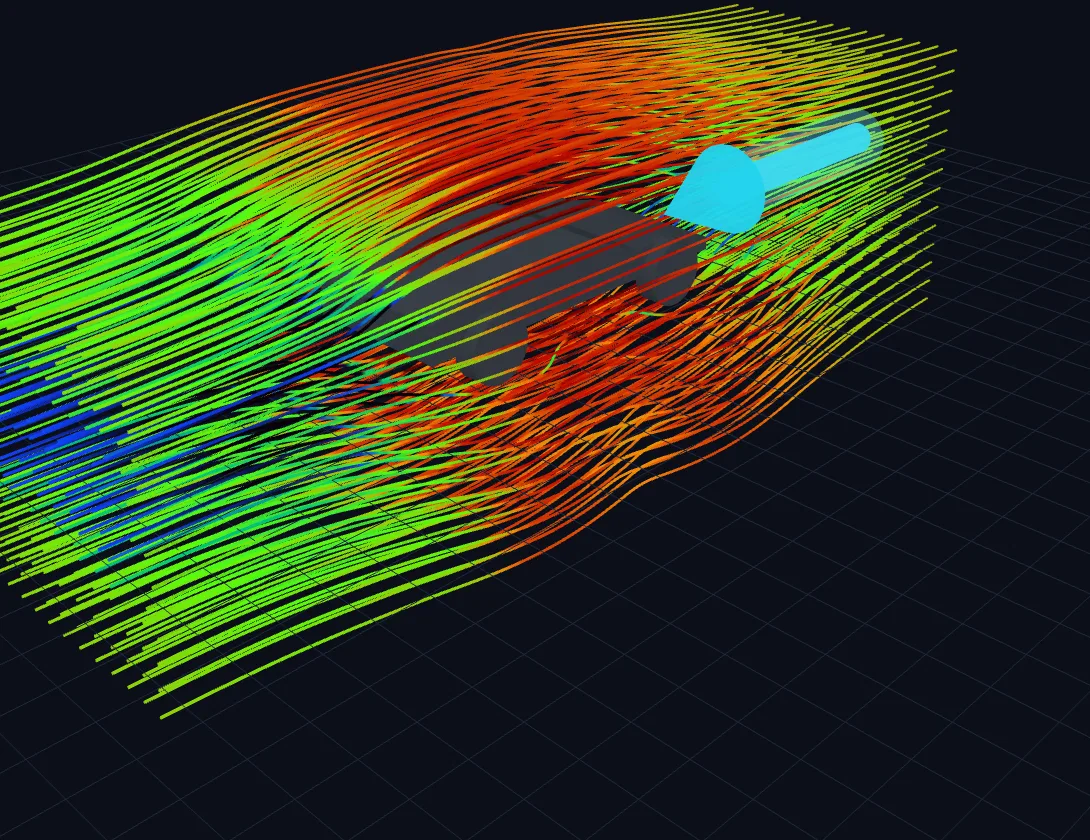
A car bends the air around it in a very deliberate way, and CFD lets you see exactly how. The picture below is a flow simulation of the air moving over a car in CFD Tunnel at 45 meters per second, with the streamlines colored by how fast the air is moving. The body here is a simplified car, but the way you read the flow is the same whether you are looking at a road car, a race car, or your own CAD.
What the colors mean
The streamlines are colored by velocity magnitude, which is just how fast the air is moving at each point. Red is fast, green and blue are slower. Air speeds up as it squeezes over and around the body, so you see red where the flow accelerates and green or blue where it slows down, like in the wake behind the car.
Where the pressure builds and drops
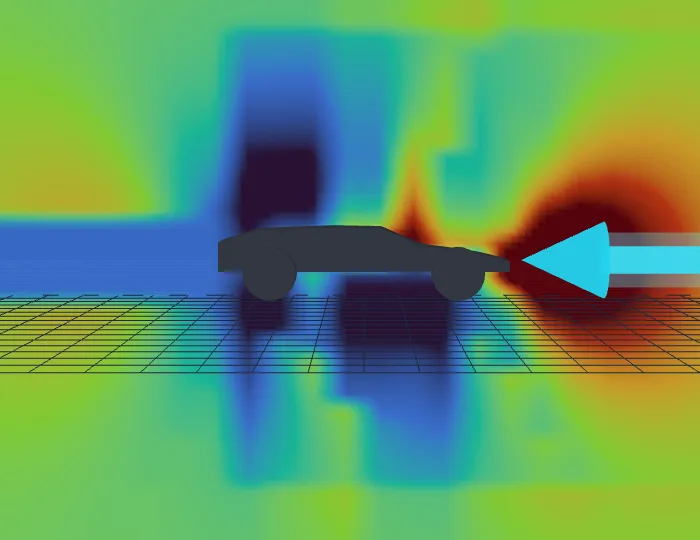
This slice cuts straight through the car and shows pressure instead of speed. The air piles up at the front where the arrow meets the nose and turns deep red, a high pressure stagnation region where the flow is brought to a stop. Over the top of the body the pressure drops into the blue, because the air has to speed up to get over the car, and by Bernoulli that fast air is low pressure. A wing uses the same effect on purpose, turning the pressure difference into downforce that presses the car into the track for more grip.
The wake behind the car
Behind the car the neat streamlines break apart into a messy, slower region, and the pressure stays low. That is the wake. A big turbulent wake means more drag, because the car is leaving a low pressure hole behind it that effectively pulls it backward. A lot of aero work is about shrinking that wake so the car slips through the air more cleanly.
Why simulate it instead of guessing
You cannot see air, so without a simulation you are guessing where it speeds up, where it separates, and how big the wake is. CFD makes all of it visible and puts real numbers on it, like the drag coefficient and the downforce, so you can change the shape and immediately see whether the flow got better or worse.
This kind of result runs in CFD Tunnel, right in your browser. You get an instant flow preview like the ones above, and when you want hard numbers you can run a full OpenFOAM solve on the same geometry. Start from a built-in car or upload your own design, set a wind speed, and watch the air move around it in 3D.